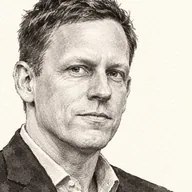
Peter Thiel

PayPal and Palantir founder, contrarian investor, author of Zero to One

7 topics · 74 distinct points

Contrarian thinking

2015–2025

“One sort of question is always like, what great business is nobody building? There's a more intellectual version of it, which I always like to ask as an interview question. It's: tell me something that's true that almost nobody agrees with you on. And this turns out to be a shockingly hard question for people to answer, and it's hard because, for one thing, it's hard because we've just been taught that truth is conventional. The truth is whatever everybody agrees on, and so coming up with something new that people don't already agree on puts us in a very uncomfortable sort of a place. It sounds like it's really hard to do this, and so you have to be really, really brilliant, so we think. But the other reason it's a very tough question to answer is because you sort of think about the literal dynamic of an interview, where I'm asking the question to somebody, and then give me an answer, and it's like, oh yeah, I already thought that, or I agree with that — that's the wrong answer. And so that the right answer is one that, in some sense, people might not agree with, and so it, I think, often requires quite a bit of courage to come up with an answer that people haven't thought of.”

Technological stagnation

2019–2026 · changed view

“And then in some ways I believe it's slowed down over the last 50 or so years Maybe 1970 or so is a is an inflection point one could one could cite it doesn't mean it's stopped altogether you know one way I've often summarized it is that we've continued to have progress in the world of bits you know computers software internet mobile internet you know maybe crypto now AI but there's been much less progress in the world of atoms.”

Competition & monopoly

2015–2024

“I think that, um, all — if you're a founder or entrepreneur, what you want to aim for is monopoly. You want to aim to build a company that is one of a kind, uh, and that it's so far, um, differentiated from the competition that it's not even competing. Um, and, um, and I think this is the — conventional wisdom is always that capitalism and competition are somehow synonyms. I believe they're antonyms. A capitalist is someone who's in the business of accumulating capital. A world of perfect compet— competition is a world where all the profits are competed away. If you want to compete like crazy, um, then you should just open a restaurant in Chicago. Um, and, um, and, uh, and I think the, the great companies, like, uh, Google, sort of the paradigm example I use, has had no serious competition in search since 2002, when it definitively distanced itself from Yahoo and Microsoft, and as a result it's been generating enormous cash flows for the last 12 years.”

Religion & the apocalypse

2019–2026

“And certainly the Girardian intuition is that one of the you know one of the things is always that you know there's this really big problem of violence and scapegoating that in some ways some sense Judaism and then Christianity it's the same story It's the same story of you know sacrifice but it's told not from the point of view of the violent community It's told from the point of view of the innocent victim And there's a certain way where it sets in process this gradual this dynamic revelation that has that leads to the sort of gradual unraveling And there are and as you stop believing in scapegoats you're forced to come up with other explanations and that includes science.”

AI and the future

2024–2026 · changed view

“The history of it was it was maybe anchored on two visions of what AI meant, and one was Nick Bostrom, Oxford prof, who wrote this book Super Intelligence, 2014, and it was basically AI was going to be this super duper intelligent thing, way, way Godlike intelligence, way smarter than any human being. And then there was sort of the, I don't know, the CCP Chinese Communist rebuttal, the Kai-Fu Lee book from 2018, AI Superpowers, I think subtitle something like the race for AI between Silicon Valley and China or something like this. And it, it was sort of, it defined AI as it was fairly low tech. It was just surveillance, you know, facial recognition technology, we would just have this sort of totalitarian Stalinist monitoring. It didn't require very much innovation, it just required that you apply things, and basically the subtext was China is going to win because we have no ethical qualms in China about applying this sort of basic machine learning to sort of measuring or controlling the population. And those were sort of like, say, two extreme competing visions of what AI would mean in the in the 2010s.”

Human nature and history

2024–2026

“there's always a question I like to ask, what is the antonym of good? And the moral antonym is evil. The functional antonym is bad. A Ferrari is an evil car because it doesn't get many miles per gallon. A Trabi is a bad car. It works.”

Science and institutions

2024

“it started as a two-front war against both excessive dogmatism and excessive skepticism. And so if you are over in the 17th and 18th century a scientist was a heterodox thinker who didn't believe in, let's say, the decayed Aristotelian scholasticism of the Catholic church and you were maybe were empirical and there were these dogmas that you were open to questioning but you also couldn't be extremely skeptical. So if you, you know, can't trust your senses and if I don't believe you're sitting there, extreme skepticism is also incompatible with science. So extreme dogmatism was incompatible, extreme skepticism is incompatible, and the problem, problem is, yeah, it's easy to be against one but if you're, you know, if you're always just against dogmatism then maybe you're too skeptical of everything and if you're always against skepticism, you know, maybe you're too dogmatic. And so there's this very complicated balance where we need to be both anti-dogmatic and anti- skeptical”