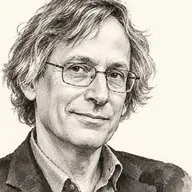
David Deutsch

Physicist and author of The Beginning of Infinity. On knowledge, optimism, the multiverse and AGI.

6 topics · 84 distinct points

Optimism & progress

2021–2026

“Optimism as I define it has to do with knowledge. It's not a prediction of the future, it's an explanation of failure. If you explain failure as being inevitable, or due to some malevolent force, insuperable malevolent force, or just the way things are, then that's a recipe for stasis, which is a recipe for failure and eventually death. Therefore I think that all failure has to be explained in the form: the reason we didn't succeed is that we didn't know how to, and the knowledge of how to is in principle attainable. We don't have it now, but we could have it in the future if we do the right thing. In fact, it follows from this whole conception of knowledge that we've been talking about all this time that optimism has to be true. Otherwise there would be a limitation, which would mean the supernatural and all that stuff that — the arguments are watertight all the way from the scientific worldview to optimism, in my view.”

Knowledge & explanation

2021–2026

“That's right. Knowledge isn't just a matter of belief, and it's not just a matter of human psychology. It is information that has causal power.”

Creativity, fun & education

2021–2026

“And my rather heterodox answer to that is that it didn't evolve for the purpose for which we now use it. It evolved for something else, namely for the transmission, or better put, for the reception of cultural knowledge, memes, cultural knowledge. So, many animals have cultural knowledge, but it's very hard to transmit. It involves things like mirror neurons or something where if you do this, then the ape can also do that. But if you do a purposeful thing, then as soon as you get to any kind of complex purpose, apes can't copy it.”

The multiverse & quantum physics

2024–2025

“Now the thing that tells us conclusively that there are parallel universes, wait for it, is that if you look at that, there are certain points on the screen where photons — let's say you have one slit open — you have where photons are arriving, and if you open the second slit, they stop arriving there. So how come? Well, obviously they must stop arriving because they know that there are two slits open now and not just one. And if you look at the mathematics of this, what determines whether they arrive or not depends on whether — how many slits are open there, 1, 2, 5, 17, they all give a different pattern, and the mathematics tells us when opening a new slit will stop light arriving at a given point.”

AI & AGI

2022–2026

“So when I say any, I'm — what I mean is that we're not limited in the programs we can run apart from by speed and memory capacity. So all limitations on us, hardware limitations on us, boil down to speed and memory capacity. And both those can be augmented to the level of any other entity that is in the universe. Because, you know, if somebody builds a computer that can think faster than the brain, then we can use that very computer or that very technology to make our thinking go just as fast as that.”

Popper & error correction

2021–2026

“That's right. That is what allows human type knowledge to have this universal reach, whereas biological knowledge, although it has enormous reach, as you said, it can make elephants trunks and giraffes necks and so on, it is actually limited because of the type of knowledge that is. For example, to evolve from one animal to another over, let's say, a thousand generations, every single generation must be viable as an animal, because the DNA strands have to be able to just replicate in every single generation, and if one of them fails, if one of them doesn't work, then the species will go extinct. Whereas humans, as the philosopher Karl Popper said, we can let our ideas die in our place, and that means that we can go through a whole bunch of — a sequence of ideas that aren't viable on the way from one viable idea to the next. We don't have to die when they're wrong.”